Wednesday, October 31, 2018

ACOSS–Welcome words on Newstart but we need action

The Australian Council of Social Service (ACOSS) welcomes the Leader of the Opposition’s clear acknowledgement today that the rate of Newstart is too low and calls on both the major parties to commit to raising the rate. 

  • “We welcome Mr Shorten’s acknowledgement of what has been clear to the community, unions, business and experts for a long time – that $39 a day is not enough to cover the basics of life. We need more than a review,” said ACOSS CEO Cassandra Goldie.
  • “We don’t need a review to know that Newstart is trapping people in poverty. We need a clear commitment to immediately increase the single rate of Newstart by at least $75 a week.
  • “The evidence is in. There is broad agreement across the community, from business groups, the union movement and a growing number of politicians, including the Greens, Labor Chief Ministers, independents and Mayors, as well as John Howard and John Hewson, that we must finally lift the rate of Newstart after 24 years. 
  • “Most people receiving Newstart live below the poverty line. It is very hard to look for a job when you don’t know where your next meal is coming from or how to put food on the table for your kids.
  • “People cannot afford to wait for relief while a review is carried out. The Morrison Government must act immediately to increase the single rate of Newstart and the Shorten Opposition needs to commit now to raising Newstart by at least $75 per week should it win government.
  • “Many of us are a job loss or a relationship break down away from relying on our social security safety net and 70% of voters believe Newstart should be increased. Politicians must heed the calls from right across the community on the need for a decent social security safety net.”

Tuesday, October 30, 2018

ACTU – Independent body needed to oversee energy shift: report

30 October 2018

The peak body for working people has backed calls for an independent statutory body to manage energy transition for working people and their communities, as a major report warning of the dangers of inaction was released.

The Ruhr or Appalachia? report from the University of New South Wales Industrial Relations Research Centre identifies key characteristics of successful and unsuccessful approaches to communities in transition globally to inform approaches to transition in Australia.

The report recommends a national transition authority to oversee the energy sector transition and protect workers and communities affected by the transition to clean energy.

Such an authority would co-ordinate support for workers through income assistance, redeployment, retraining and early retirement.

The report also recommends programs to facilitate investment in high-tech industries and services in affected areas, and public sector infrastructure investment to create local employment in affected areas.

Quotes attributable to ACTU Secretary Sally McManus:

  • “People working in industries, regions and communities that are exposed to energy transition have contributed a huge amount to Australia. Their wellbeing should be ensured as our energy system changes. Communities that are facing transition must flourish, not just survive.
  • “International experience shows that without firm, competent and consistent direction from a national body, people in coal-power dependent communities can suffer enormously.
  • “That’s why we need an independent statutory body to manage energy transition and make sure that communities and people at the heart of this transition benefit from it.
  • “We know that this is achievable because it has been done before – in Germany, in the Netherlands and in Singapore for instance.
  • “We also know that getting it wrong can cause enormous suffering and poverty, as we have seen in the Appalachian region of the USA.
  • “It’s up to our leaders to choose the path that will look after working Australians affected by energy transition and allow communities and regions to thrive.”


Saturday, October 27, 2018

The targeting of Trump critics reveals about America's rotting core

Political violence in the United States has tended to come in two forms. The first consists of simply unhinged acts, like John Hinckley Jr shooting Ronald Reagan in the hope of impressing the actress Jodie Foster, or Timothy McVeigh hoping to bring down the government with a bomb. The second is more systematic and sinister: the violence used to keep down groups who threaten the social and political order. This is the violence of strikebreakers and the KKK. It is the violence that killed Emmett Till, an African-American teenager who was lynched in Mississippi in 1955 after allegedly wolf-whistling at a white woman.

Has age of Trump's violent rhetoric brought 'the awful' back to US politics?

A key feature of the second type of violence is that it has often been perpetrated by private individuals while serving the interests of public authorities. This is why the authorities encourage it. Till’s killers walked free because Mississippi’s court system would not convict them, understanding that their act reinforced white supremacy at a time when it was under threat from desegregation. This was violence of the people, by the people, for the government.

This is the correct context in which to understand the bomb scares that have recently affected Barack Obama, the Clintons, Eric Holder, George Soros and others. We don’t yet know the state of mind of those responsible. But the identity of the targets chosen (primarily women, African Americans and a Jew) and the fact they are all known enemies of the president of the United States tells us something deeply disturbing about the state of America today.

Unhinged threats and acts of violence have been on the rise in American politics recently, such as the shooting last year of Republican congressman Steve Scalise. But most notable of all and influential for the culture has been the rise of a president who talks frequently and vividly about the desirability of violence being done to his opponents, and supporters who revel in it.
The nationalism that fuels Trump’s movement is based on the idea that the country can be divided into two groups. One is the pure and virtuous true Americans, the overwhelmingly white crowd who come to his rallies. The other group consists of minorities, elites and Democrats who stand poised to sell out the “real” Americans if they are given a chance.

Hence Trump’s political opponents are cast as “globalists” who “want the globe to do well, frankly, not caring about our country”. They support “caravans” of “unknown Middle Easterners” (read: terrorists) who are coming to threaten the security of the country. They rely in elections on the votes of millions of non-American “illegals”, as Trump suggested of Hillary Clinton in 2016. Most of all, Trump has been obsessed with overturning the legacy of his first political foil, President Obama, who he alleged was literally foreign-born and hence not a real American.

The threat of violence has never been far behind. Trump suggested that Obama was the “founder” of Isis and that the group, which the US is pledged to destroy, “honors” him. He said that “second amendment people” might be best-placed to deal with Hillary Clinton. Only last week he praised a Republican congressman for body-slamming a Guardian journalist who asked him a question he didn’t like.

 It is no surprise that this febrile atmosphere, in which any lie can be justified if it paints the president’s opponents as traitors, would lead to violence
Trump and his supporters see themselves as engaged in an apocalyptic struggle to defend America against a coalition of liberal whites and ethnic minorities who seek to degrade it. They are fueled by a conservative media machine which simply invents lies and outlandish conspiracy theories if they serve the needs of the movement – such as that the recent spate of attempted bombings was carried out by liberals seeking to embarrass President Trump.

It is no surprise that this febrile atmosphere, in which any lie can be justified if it paints the president’s opponents as traitors, would lead to violence. But what is particularly disturbing is that the propaganda that inspires this violence has been outsourced to private organizations, meaning no simple change of government by election can end it. Nowadays, even the president himself gets his daily talking points by parroting Fox News, which he believes over his own government officials. The rot is pernicious and deep, and it will inevitably lead to more violence.

 The worst aspect of the US attempted bombings? Their air of inevitability

In other times and places, groups of private individuals willing to deploy violence on behalf of a particular vision of the state have been instrumental in the rise of fascism. America, because it still has strong institutions despite the damage of the Trump era, is not there yet. But parts of the foundation are sinking into place, and it is unlikely they can be uprooted without a concerted effort.

Changing course depends on Trump’s brand of nationalism not being seen to pay political dividends. The question of whether the conservative movement will play with fire in order to gain power is no longer in doubt; they will and they are. The question now is whether they can get away with it. The election in two weeks will either be a warning to them or a vindication – a vindication that might tempt the president and his followers inside and outside of government to who knows what extremes in the future.

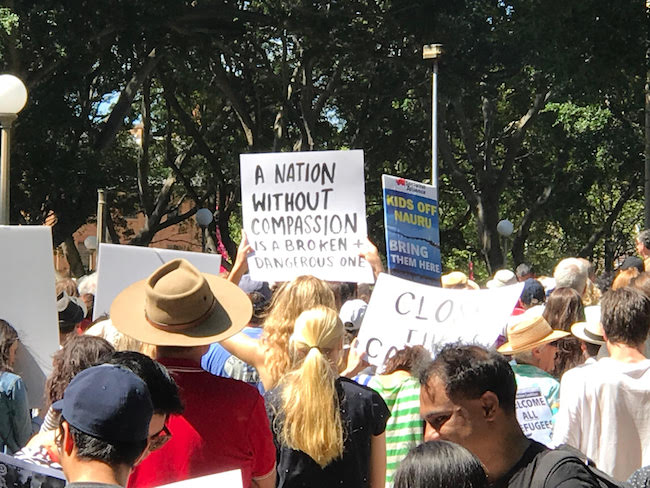
Growing Sydney Support For Refugees


Friday, October 26, 2018

ACTU – Fair Pay Rises Needed To Save Our Savings

25 October 2018

Working people will soon be forced to raid whatever long-term savings they have to keep up with the rapidly rising cost of living thanks to flat-lining wage growth according to federal Treasury secretary Phil Gaetjens.

Household savings are at a 10 year low at around 1 per cent of income after spending. Using these savings for everyday expenses is completely unsustainable.

Wages are going backwards in real terms for most Australian workers while the cost of everyday expenses like energy, housing and transport grow significantly faster than CPI.

In the year to June 2018:

  • Childcare increased by an average 6%
  • Housing increased by an average 3.1%
  • Electricity increased by an average 10.4%
  • Gas increased by an average 7.10%
  • Transport costs increased by an average 5.2%
  • Health costs increased by an average 3.4%
  • Education costs increased by an average 2.7%
  • In the six years to June federal politicians enjoyed an average annual pay increase of 5.34%, while working people’s average wages stood still or went backwards in real terms.

Quotes attributable to ACTU President Michele O’Neil:  


  • “People are being driven to desperation by the Morrison Government’s refusal to address the wage growth crisis.
  • “Kelly O’Dwyer is out of touch with working people. They are about to dig into their savings to make ends meet, and she refuses to accept that there is an issue.
  • “The Abbott/Tunrbull/Morrison government has actively worked against  working people trying to get fair pay rises. It has slashed penalty rates, presided over a massive drop in enterprise bargaining and backed big business at every turn.
  • “The government has to accept that its trickle down economic experiment has failed. Working people are in the middle of a wages crisis and its hurting the economy.
  • “The government has fought  against harsher penalties for wage theft and better legal rights for workers to easily claim back the money they are owed, against sector bargaining which would give working people the tools to win fair pay rises, and against working peoples right to a living wage not just a minimum wage.
  • “We need to change the rules for working people so that we win fair pay rises that stay ahead of the cost of living.”