Fantastic news: Shell has announced that it will NOT attempt to drill in the Arctic Ocean this summer.
The oil giant’s stunning reversal came after a momentous court ruling two weeks ago. The federal court agreed with NRDC and our allies that the Bush Administration had wildly underestimated the risks of spills and other hazards when it opened the Arctic’s Chukchi Sea to oil leasing and exploration in 2008.
Simply put: the entire Arctic leasing program was based on a fiction -- as we have long claimed -- and all the leases, including Shell’s, have now been thrown into limbo.
The court victory and Shell’s retreat are huge steps forward in our campaign to close Alaska’s Polar Bear Seas -- the Beaufort and Chukchi -- to oil development and potential catastrophe.
And we have you to thank! You have stood with us every step of the way, lending your generous financial support to a tough battle against two administrations and Big Oil that has raged in and out of the courtroom for five years. We never gave up because we know just how much is at stake.
The Beaufort and Chukchi Seas are home to more than half of America’s polar bears. Their populations are already reeling from global warming. The last thing they need is a catastrophic oil spill.
And if Shell’s Arctic venture has proven anything, it’s that this remote and rugged region is no place for drilling. In 2012, Shell’s rig had to flee from a 30-mile-long iceberg. Its emergency response equipment was “crushed like a beer can” during tests. And its drill rig ran aground during relatively routine winter weather.
Other oil giants -- including ConocoPhilips and Statoil, the Norwegian multinational oil company -- have long since canceled or suspended their plans. Shell was the last holdout -- until this latest announcement.
But make no mistake: While Shell has called off this summer’s operations, it is far from ruling out another attempt.
That’s why it’s so crucially important for the Obama Administration to slam the door shut on Arctic drilling by putting it completely off-limits to Big Oil.
This latest federal court decision hands President Obama a golden opportunity to move beyond a failed Bush Administration policy and to safeguard the Arctic for the sake of our spectacular natural heritage and our embattled climate.
Thursday, February 06, 2014


Wednesday, February 05, 2014
Nurses take a stand for universal healthcare

by Lee Thomas, Federal Secretary of the ANMF
MEDICARE works for everyone in our community.
It’s as simple as that. Thirty years after the introduction of Medicare, our healthcare system continues to provide world-class care for all, regardless of background, age, financial resources or where you come from.
Of real concern in the last few weeks is that Prime Minister Tony Abbott has refused to rule out the introduction of a $6 up-front charge to attend your local General Practitioner (GP) even if they already bulk bill.
Make no mistake, an upfront fee will have a huge impact on services and the way those in most in need think about healthcare and how they use it for themselves and their family.
People in our community who can least afford it would eventually be forced to pay for what should be free healthcare. The introduction of any co-payment will be the beginning of the end for free, universal healthcare in Australia.
Our universal healthcare system is the envy of the world – we should fight very hard to keep it free.
Further burden nurses and ED’s
The introduction of a co-payment by the Abbott Government would simply shift the cost burden to the public health system, because many people would head to the hospital Emergency Department (ED) to get checked for routine or relatively minor ailments rather than paying rising upfront fees to see the local doctor.
This will further burden nurses who are already struggling with dangerously high workloads in overstretched EDs.
Waiting times would just get longer, resources stretched even further and staff in EDs would bear the burden of this Government decision on a daily basis.
WATCH: the very first Medicare advertisement from 1983
You only have to look at the result of the Higher Education Contribution Scheme (HECS) to realise that initially small co-payments can become very large burdens.
Healthcare is already overstretched
The Australian Nursing and Midwifery Federation has over 230,000 union members in Australia, in each State and Territory, in public and private hospitals, nursing homes, and GP clinics.
Our members, nurses and midwives and assistants in nursing are the face of healthcare policy in Australia.
We see people in the worst and best of times, when they are sick and the most vulnerable, when they need compassion and understanding.
And that really is the heart and soul of our healthcare system – providing equally for all, decent, quality, healthcare, whether you are rich or poor, regardless of your age and background, we will see you and treat you and care for you.
And we should never, ever want that to change.
AMWU: Abbott Ideology Undermines Manufacturing
The AMWU has condemned the Federal Government for its decision to abandon industry assistance to the SPC Admona Plant.

The current Government has now clearly shown that it believes the only way to achieve productivity is to cut wages, conditions and jobs and that it has no role to play in supporting Australian industry.
Prime Minister Tony Abbott blamed the workers at the Ardmona plant for SPC s woes, and noted they needed to be more flexible in order for the industry to survive.
The union and workers at the SPC plant have already been working in cooperation with plant management to improve productivity, said AMWU National Secretary Paul Bastian.
For the Prime Minister to suggest that the potential closure of the Ardmona plant is due to the workers is to ignore the mess in the Government s own backyard.
The real factors that have impacted SPC are matters beyond the company s control, including:
Mr Bastian said that the decision flies in the face of the Government s own advice from the Productivity Commission, its own panel of experts, the interests of the local community and the strong opposition of the local coalition MP.
This decision is not in the interests of anyone," Mr Bastian said.
"It is based on a naive and cruel desire from this government to maintain their ideological purity when it comes to manufacturing support at the expense of thousands of jobs and whole industries. We have seen it with Holden and now we have seen it with SPC Ardmona,
The government directly and indirectly subsidies mining, agriculture, finance, fisheries and other important Australian industries and yet it is continually cutting investment in manufacturing.
Today is a sad day for all Australians. Soon, when we go to the supermarket and look down the canned-goods aisle, there will be nothing left made in Australia, said Mr Bastian.
The current Government has now clearly shown that it believes the only way to achieve productivity is to cut wages, conditions and jobs and that it has no role to play in supporting Australian industry.
Prime Minister Tony Abbott blamed the workers at the Ardmona plant for SPC s woes, and noted they needed to be more flexible in order for the industry to survive.
The union and workers at the SPC plant have already been working in cooperation with plant management to improve productivity, said AMWU National Secretary Paul Bastian.
For the Prime Minister to suggest that the potential closure of the Ardmona plant is due to the workers is to ignore the mess in the Government s own backyard.
The real factors that have impacted SPC are matters beyond the company s control, including:
- SPC have been the victim of dumping but the Government refuses to impose anti-dumping duties on the cheap dumped canned fruit coming into Australia.
- The tomatoes producers in Italy, which are undercutting SPC, are being investigated for links to organised crime, but the Government won t provide a life line to SPC while these investigations continue.
- While SPC adheres to strict quality standards to ensure every single product is top quality and safe, imports which don t meet these standards are coming into the market and undercutting SPC s business.
- Just last week 2 out of 10 randomly tested cans of fruit from China were found to contain dangerous levels of lead.
- The high Australian dollar has put huge pressure on Australian manufacturing, including SPC and still does.
Mr Bastian said that the decision flies in the face of the Government s own advice from the Productivity Commission, its own panel of experts, the interests of the local community and the strong opposition of the local coalition MP.
This decision is not in the interests of anyone," Mr Bastian said.
"It is based on a naive and cruel desire from this government to maintain their ideological purity when it comes to manufacturing support at the expense of thousands of jobs and whole industries. We have seen it with Holden and now we have seen it with SPC Ardmona,
The government directly and indirectly subsidies mining, agriculture, finance, fisheries and other important Australian industries and yet it is continually cutting investment in manufacturing.
Today is a sad day for all Australians. Soon, when we go to the supermarket and look down the canned-goods aisle, there will be nothing left made in Australia, said Mr Bastian.
Greg Hunt Goes Feral On Australian Wilderness Heritage
In June last year, Tasmania's spectacular ancient forests were awarded the highest global protection - World Heritage status.
This outcome was a centrepiece of the historic Tasmanian Forest Agreement, with forestry unions and the Tasmanian timber industry jointly supporting World Heritage listing of Tasmania’s forests for the first time.
It was an incredible win - for nature, for people, and for our economy.
But despite this unprecedented support, the Federal Government is now seeking to remove these forests from Tassie’s World Heritage Area.
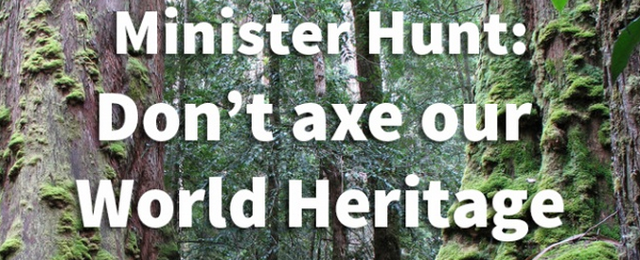
On the 31st January, Minister Hunt applied to the World Heritage Committee to cut large tracts of wild, old growth forest from the new World Heritage Area. This will allow logging in places like the Upper Florentine, Weld and Great Western Tiers; some of the most loved and beautiful forests in the world.
Bizarrely, the Coalition’s forestry spokesman, Senator Richard Colbeck, claims that this will strengthen, not weaken, the protection of Tasmania’s wilderness.
But the Australian people know better. These forests belong to all of us - that’s what World Heritage means. And if we all speak together, we can get Minister Hunt to come to his senses and drop this application.
The Coalition has no support for this move - instead, they are allowing political operatives to push ideology before common sense.
The forestry industry and unions continue to actively support the World Heritage listing of forests, because they know it’s important to the Tasmanian Forest Agreement, to their markets, and to Tasmania’s economy.
Polling shows that the Tasmanian community is well and truly behind the Forest Agreement, with World Heritage protection at its centre. The Tasmanian Government, the independent Tasmanian Upper House, and the former ALP Federal Government supported World Heritage protection. And the highly respected World Heritage Committee, supported by 190 nations, listed these forests through a rigorous process and vote.
It seems that the Australian Environment Minister is the only one who thinks that axing old growth forests is a good idea.
Wilderness Society
This outcome was a centrepiece of the historic Tasmanian Forest Agreement, with forestry unions and the Tasmanian timber industry jointly supporting World Heritage listing of Tasmania’s forests for the first time.
It was an incredible win - for nature, for people, and for our economy.
But despite this unprecedented support, the Federal Government is now seeking to remove these forests from Tassie’s World Heritage Area.
On the 31st January, Minister Hunt applied to the World Heritage Committee to cut large tracts of wild, old growth forest from the new World Heritage Area. This will allow logging in places like the Upper Florentine, Weld and Great Western Tiers; some of the most loved and beautiful forests in the world.
Bizarrely, the Coalition’s forestry spokesman, Senator Richard Colbeck, claims that this will strengthen, not weaken, the protection of Tasmania’s wilderness.
But the Australian people know better. These forests belong to all of us - that’s what World Heritage means. And if we all speak together, we can get Minister Hunt to come to his senses and drop this application.
The Coalition has no support for this move - instead, they are allowing political operatives to push ideology before common sense.
The forestry industry and unions continue to actively support the World Heritage listing of forests, because they know it’s important to the Tasmanian Forest Agreement, to their markets, and to Tasmania’s economy.
Polling shows that the Tasmanian community is well and truly behind the Forest Agreement, with World Heritage protection at its centre. The Tasmanian Government, the independent Tasmanian Upper House, and the former ALP Federal Government supported World Heritage protection. And the highly respected World Heritage Committee, supported by 190 nations, listed these forests through a rigorous process and vote.
It seems that the Australian Environment Minister is the only one who thinks that axing old growth forests is a good idea.
Wilderness Society
Temporary Visa Workforce Grows - Jobs Dry Up on Abbott’s Watch
Source: CFMEU C & G News
The Construction Forestry Mining and Energy Union (CFMEU) said today that new figures provide more evidence the Abbott government is not serious about protecting Australian jobs.
Immigration Department figures show that at 31 December 2013, the total number of 457 visa holders in Australia was 178,980[1], an increase of 11,960 or 7.6 per cent more than the numbers at end-December 2012.
The 457 figures were released the same day as the ANZ Job vacancies survey, showing a continuing decline in job vacancies Australia-wide in January 2014, after a 10 per cent decline over 2013 as a whole.
“The number of 457 visa holders in Australia should not be increasing, it should be falling,” CFMEU National Assistant Secretary Dave Noonan said today.
“The Australian job market is in a desperate state, especially for young people, and the Abbott government’s temporary visa policies are making it much worse for them.
“As well as refusing assistance to the car industry and SPC, the Government itself is predicting that unemployment will rise to 6.25 per cent. That means it will be even tougher for young people looking for apprenticeships and their first full-time job.”
“But incredibly the Abbott government allows the vast majority of employers to get 457 visas for foreign nationals, without even having to advertise the jobs for Australian workers let alone prove that none were available.
“And in the few cases where employers do have to ‘search’ for Australian workers before 457 visa workers are approved, employers can easily avoid their legal responsibility to employ Australians first – because the government has given employers so many loopholes.”
Other figures released today show that the number of young foreign nationals aged 18-30 in Australia on Working Holiday Visas (WHVs) has also continued to soar. At 31 December 2013, there were 178,980 WHV holders in Australia – up 16,500 on end-December 2012, or a 10 per cent increase.
“The WHV program currently has no caps on numbers of visas granted and is poorly regulated in the workplace, disadvantaging young Australian job seekers. Among other things, employers currently transfer over 10,000 WHV holders per year straight on to 457 visas, bypassing young Australians.
“The WHV program must be brought under much more control, with numbers capped to start with.”
The Construction Forestry Mining and Energy Union (CFMEU) said today that new figures provide more evidence the Abbott government is not serious about protecting Australian jobs.
Immigration Department figures show that at 31 December 2013, the total number of 457 visa holders in Australia was 178,980[1], an increase of 11,960 or 7.6 per cent more than the numbers at end-December 2012.
The 457 figures were released the same day as the ANZ Job vacancies survey, showing a continuing decline in job vacancies Australia-wide in January 2014, after a 10 per cent decline over 2013 as a whole.
“The number of 457 visa holders in Australia should not be increasing, it should be falling,” CFMEU National Assistant Secretary Dave Noonan said today.
“The Australian job market is in a desperate state, especially for young people, and the Abbott government’s temporary visa policies are making it much worse for them.
“As well as refusing assistance to the car industry and SPC, the Government itself is predicting that unemployment will rise to 6.25 per cent. That means it will be even tougher for young people looking for apprenticeships and their first full-time job.”
“But incredibly the Abbott government allows the vast majority of employers to get 457 visas for foreign nationals, without even having to advertise the jobs for Australian workers let alone prove that none were available.
“And in the few cases where employers do have to ‘search’ for Australian workers before 457 visa workers are approved, employers can easily avoid their legal responsibility to employ Australians first – because the government has given employers so many loopholes.”
Other figures released today show that the number of young foreign nationals aged 18-30 in Australia on Working Holiday Visas (WHVs) has also continued to soar. At 31 December 2013, there were 178,980 WHV holders in Australia – up 16,500 on end-December 2012, or a 10 per cent increase.
“The WHV program currently has no caps on numbers of visas granted and is poorly regulated in the workplace, disadvantaging young Australian job seekers. Among other things, employers currently transfer over 10,000 WHV holders per year straight on to 457 visas, bypassing young Australians.
“The WHV program must be brought under much more control, with numbers capped to start with.”
Subscribe to:
Posts (Atom)