Thursday, November 22, 2018

ACTU – Super plan no substitute for paid family domestic violence leave

20 November 2018

The peak body for working people says a Morrison Government plan to allow women escaping violence to dip into their superannuation and take on debt to fund the significant cost of leaving is inadequate.

The ACTU is campaigning for 10 days’ paid family and domestic violence leave, saying that such leave is necessary on both social and economic grounds for women who want to escape violence.

Today Minister for Women Kelly O’Dwyer will announce a plan that will see women escaping violence expected to dip into their superannuation and take out micro-finance loans instead of having a guaranteed right to access paid family and domestic violence leave.

Women currently retire with 47 percent less super than men on average, according to the ASU and Per Capita’s Not So Super for Women report.

Paid family and domestic violence leave would cost only five cents per employee per day and has been included in a number of public and private sector industrial agreements, including all NSW Government employee awards.

Both the ALP and the Greens support the ACTU call for 10 days’ paid family and domestic violence leave.

The ACTU welcomed some other aspects of Ms O’Dwyer’s announcements, including the restoration of the ABS time use survey and changes that will prevent people who have experienced family and domestic violence being cross-examined by their abuser in court.

The changes to paid parental leave are a small step in the right direction. The ACTU has called for the abolition of primary and secondary carers’ leave and for 26 weeks’ leave to be granted to expecting parents to be used however the family chooses.

Quotes attributable to ACTU President Michele O’Neil:  

  • “Women experiencing family and domestic violence need leave to be able to leave. It’s long past time for 10 days’ paid family and domestic violence leave.
  • “In 2018 women escaping violent relationships should not have to choose between their income and their safety. And they should not have to spend their retirement savings or take on debt.
  • “Our broken system already sees women retire with 47 percent less than men. Forcing women to dip into their super is likely to make worse women’s already inadequate retirement savings.
  • “Paid family and domestic violence leave is vital for women escaping violence. It’s the right thing to do, and every major party except Ms O’Dwyer’s recognises that it’s time to write it into law.”


Wednesday, November 21, 2018

Bill Shorten to adopt Malcolm Turnbull's energy policy

Bill Shorten to adopt Malcolm Turnbull's energy policy, pledges to throw billions at renewables
By political editor Andrew Probyn

Australian households will be offered federal rebates to install solar storage batteries under a federal Labor energy policy that will also direct billions of taxpayer dollars at solar, wind and hydro projects.

Key points:


  • Labor to adopt Malcolm Turnbull's National Energy Guarantee (NEG)
  • Rebates for households and businesses to install batteries if Labor wins election
  • Pledge of $10 billion for Clean Energy Finance Corporation
  • With climate and energy expected to be subjects of fierce battle ahead of the election next year, Opposition Leader Bill Shorten will unveil Labor's long-awaited policy on Thursday.


The ABC understands Mr Shorten will formally adopt former prime minister Malcolm Turnbull's ill-fated National Energy Guarantee (NEG) as Labor policy.

Though Mr Shorten is likely to frame ALP adoption of the NEG as an attempt to find common ground with the Coalition on energy and climate change, it will also serve to give Labor political cover against Coalition attack.

The NEG, which was enthusiastically backed by then-energy minister and current Treasurer Josh Frydenberg, was twice supported by the Liberal party room but was dropped in August after some Coalition conservatives continued agitating against the policy.

Mr Shorten will recommit a Labor Government to a 45 per cent emissions reduction target by 2030, based on 2005 levels.

He will promise massive spending on renewable energy projects, with the Clean Energy Finance Corporation (CEFC) to have its funding topped up to $10 billion.

Extra rebates will be offered to households and businesses installing batteries to store solar energy, with Mr Shorten expected to argue that increased battery storage will improve reliability of the electricity grid.

Tuesday, November 20, 2018

Hands Off ABC – Then As NOW – from 1976

Reflection on Referendums

Reflection on Referendums
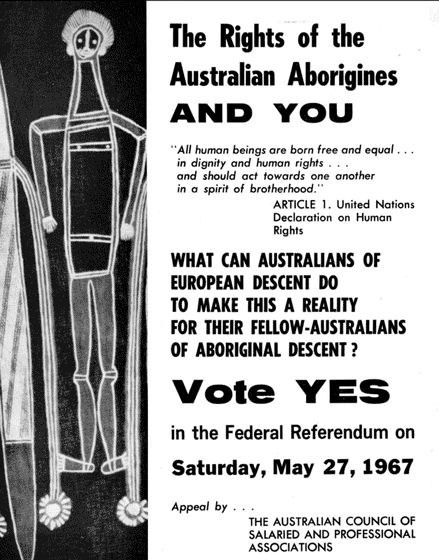
May 27th, 2017 marks the 50th anniversary of the 1967 Referendum.
Most Australians think this Referendum gave Aboriginal Australians the right to vote.  That is not so.  Aboriginal people had the right to vote in all Australian elections well before the referendum of 1967.

The questions posed to the Australian people in the 1967 Referendum were about changing two sections of the Constitution, one which excluded Commonwealth government involvement in the welfare of Aboriginal people, and another which prevented Aboriginal people from being included in Commonwealth censuses.  90.77% of Australian people voted in favour of the changes proposed in the referendum.
Successful referenda are hard come by in Australia.  The overwhelming result of the 1967 Referendum came after decades of campaigning by Aboriginal people that they have the same rights as other Australians. There is no doubt the result had great symbolic meaning for Aboriginal people who saw it as ensuring the rights and protections of Australian citizenship were available to all Australians.
So how much has changed for Aboriginal people in the 50 years since the 1967 referendum?
Given the disparity that still exists between Aboriginal and non-Aboriginal Australians on every major social and economic measure, the anniversary of the Referendum gives us another opportunity to highlight that much still needs to be done to ensure every Australian has by right, a living standard commensurate with citizenship in a developed country.
Presently work is being undertaken on the wording of another referendum question about the place of Aboriginal people in the Constitution and soon it will be put to the Australian people.  As it is presently worded, the Constitution reads as if Australia’s national story began with the arrival of the British colonists. Its wording also allows the Commonwealth government to discriminate against people on the basis of their race. The new referendum aims at making changes in both these areas.
When the wording of the questions to be put in this next referendum are agreed, and assuming it is passed by the Australian people, (wouldn’t it be wonderful to have a similar positive response to that achieved in 1967) we cannot assume that there is nothing more in relation to Aboriginal people we as a nation need to address.
There is still the issue that there has never been any agreement between the descendants of the Australia’s First People and the descendants of those who have come later as to how we will share the rights, responsibilities and resources of this land. Two states, Victoria and South Australia, have begun conversations with their Aboriginal people about what a shared sovereignty in their states might look like.
The rest of the nation would do well to consider doing the same.
Laraine Crowe rsj

Monday, November 19, 2018

Joseph Stigliitz Backs Union Demands

Nobel prize winning economist Joseph Stiglitz has backed unions on penalty rates, saying cuts to Sunday rates in Australia are an indication that workers’ power has been eroded.


"The economy is supposed to be helping increase people's living standards - and part of living standards is enjoying leisure," Professor Stiglitz said.

"If you have to work on a Sunday, you should get compensated ... And the background of this [is that] the bargaining power of workers has been eviscerated. They would want to say 'I don't want to work on a Sunday' - but they can't say that."

Joseph Stiglitz, economics professor at Columbia University, says governments must act to address inequality.

The respected American economist and Columbia University professor, who is in Australia to accept the Sydney Peace Prize, also supports the Australian Council of Trade Unions' demand for industry-wide bargaining, which he sees as necessary to address weak wage growth.

"When you don't have any collective voice for workers, obviously workers are not going to do as well," he said.

It comes as the latest data from the Australian Bureau of Statistics reveals that hourly pay rates increased 2.3 per cent nationally over the past 12 months, marking the highest annual growth rate in three years.

Unions argue the increase, which came after the Fair Work Commission raised the minimum wage by 3.5 per cent, is insufficient to offset the rising cost of living.

In a speech at the National Press Club in Canberra on Wednesday, Professor Stiglitz called on governments to address inequality and warned that doing so was crucial to a well-performing economy.

He urged Australia to learn from the mistakes of the United States, where he said worker rights had been eroded through a series of policy failures based on trickle-down economics.

"It used to be that we thought that you could only get more equality by sacrificing economic growth," he said.

"That view is no longer accepted ... Having a progressive agenda with greater equality leads to higher economic growth and that higher economic growth then generates more tax revenue-  and that more tax revenue gives you a source of funding for more progressive reforms that can make a more inclusive society."

Labour, competition and taxation laws had been restructured in a way that led to "slower economic growth and more inequality", he said, adding: "What paltry economic growth has occurred, the benefits have all gone to the top."

Professor Stiglitz said large segments of the population had been locked out of the middle class as corporations increased their profit margins while refusing to pass on productivity gains to workers.

He said penalty rates should not be eroded, and that governments must act to protect workers.

"Having a life where you don't get the same time off that everyone else does is really interfering with your wellbeing," he said.

"That's why there's a really important role for a government to set hours and overtime standards."

The Fair Work Commission decided to cut Sunday and public holiday penalty rates for full-time and part-time workers in February.

Opposition Leader Bill Shorten has promised to reverse penalty rate cuts within 100 days of a Labor government being elected.

Mr Shorten has also said he will consider the ACTU's industry wide bargaining proposal, which would empower workers to strike across industries.

Unions lost a bid to overturn the commission's penalty rates decision in the Federal Court last month.

Hospitality workers' Sunday rates were cut from 175 per cent of their standard wage to 150 per cent; in the retail sector, the drop was from 200 per cent to 150 per cent.