Tuesday, May 03, 2016

Dutton abuses refugee advocates

Australia blamed refugee advocates on Tuesday for "encouraging" asylum seekers held in remote camps towards acts of self-harm after a woman set herself on fire, while the United Nations renewed its criticism of Australia's harsh immigration policy.

Australian officials said an unidentified 21-year-old Somali woman was in a critical condition after she set herself alight at an Australian detention camp on the tiny South Pacific island of Nauru on Monday, the second such incident in a week.

A 23-year-old Iranian man also set himself on fire last week in protest against his treatment on Nauru and later died. The Somali woman has been transferred to Australia for treatment, officials said.

Under Australia's hardline immigration policy, asylum seekers intercepted trying to reach Australia after paying people smugglers are sent for processing to camps on Nauru, which holds about 500 people, and on Manus Island in Papua New Guinea. They are told they will never be settled in Australia.

The Papua New Guinea government ordered the Manus Island camp, which holds about 850 people, closed last week after its Supreme Court ruled the facility illegal.

The harsh conditions and reports of systemic child abuse at the camps have drawn wide criticism inside and outside Australia and have become a major headache for Australian Prime Minister Malcolm Turnbull during campaigning for July national elections.

Australia however has vowed there will be no change to the policy, which has been pursued by successive governments.

On Tuesday, Immigration Minister Peter Dutton acknowledged there had been a rise in cases of self-harm in the camps but accused refugee advocates of giving the asylum seekers false hope they would one day be settled in Australia.
Her said some advocates were "encouraging some of these people to behave in a certain way".

"The recent behaviours in Nauru are not protests against living conditions. They aren't protests against health care, they aren't protests against the lack of financial support," Dutton told a news conference in Canberra.

However, the peak U.N. body for refugees said such incidents in the camps, which hold asylum seekers fleeing violence in the Middle East, Afghanistan and South Asia, were a result of Australia's tough offshore detention polices.

"These people have already been through a great deal, many have fled war and persecution, some have already suffered trauma," the office of the United Nations High Commissioner for Refugees in Australia said in a statement.

"The consensus among medical experts is that conditions of detention and offshore processing do immense damage to physical and mental health," it said.

Germany: Incentives for Electric Cars

Germany is set to launch a new incentive scheme worth about 1 billion euros ($1 billion) to get more consumers buying electric cars as it struggles to meet a target of bringing 1 million of them onto its roads by the end of the decade.

The costs of the incentives, similar to those already established in some other European countries, are to be shared equally between the government and automakers with a view to selling an additional 400,000 electric cars, Transport Minister Alexander Dobrindt said on Wednesday.

Critics say higher electricity generation to charge battery cars will increase carbon dioxide emissions.

Currently Germany, the biggest car market in Europe, has only about 50,000 purely battery-powered vehicles and plug-in hybrids among the 45 million cars using its roads.

Under the plans, agreed early on Wednesday between government ministers and representatives of Volkswagen, Daimler and BMW, electric car buyers will get a 4,000-euro discount while buyers of plug-in hybrid vehicles will get a discount of 3,000 euros.

"With this, I believe we will be able to give a boost to quickly move the number of vehicles (sales) to a considerable level," Finance Minister Wolfgang Schaeuble said.

The program includes 300 million euros of spending on charging stations and could start as early as May, Schaeuble said, adding that the government was considering further steps like tax incentives to make electric cars even more attractive.

"It's true that the government may have left carmakers with too much wiggle room on emissions and industry certainly pushed things to a limit there," Bankhaus Metzler analyst Juergen Pieper said. "But the decision to kick-start demand for EVs is right, other countries are doing this too for good reasons."

IG Metall, Germany's biggest trade union, said the decision should help secure jobs. "This step was urgently needed," said the head of the union, Joerg Hofmann.

The car industry has repeatedly urged Germany to help boost demand for electric cars.

But lawmakers within Chancellor Angela Merkel's Christian Democrats have criticized the idea of subsidizing private car sales, as have environmental and taxpayers' lobbies.

They say the government should instead use the money to fund the electrification of taxi and car-sharing fleets and invest in public transport.

"The incentive for electric cars is a big mistake," Clemens Fuest, head of the Munich-based Ifo economic institute which surveys business morale, told Reuters, noting that funds would be better spent on promoting new technologies as higher electricity generation to charge battery cars will increase carbon dioxide emissions.

While the Volkswagen emissions scandal has highlighted Europe's heavy reliance on diesel cars, other countries in Europe already have incentive schemes in place to get more consumers to buy electric vehicles, including Norway, the Netherlands, France and the UK.

"In countries where the government is providing an impetus, electric mobility is growing more quickly," Matthias Wissmann, head of Germany's VDA auto industry lobby said.

BMW, Mercedes-Benz and VW's Audi - the world's largest producers of luxury cars - rank only 12th, 14th and 22nd in terms of annual sales of electric and hybrid vehicles, trailing leaders Toyota, Honda, Lexus and Nissan, according to figures compiled by LMC Automotive.
But the premium car makers will not benefit from the new sales incentives because cars with a net price tag of more than 60,000 euros are not eligible, Schaeuble said.

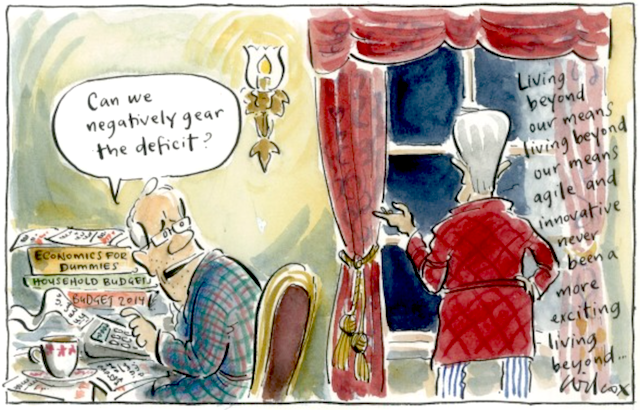
Morrison's budget woes


Papua: 500 people detained in Jayapura

Indonesian police on Monday detained hundreds of pro-independence demonstrators in the eastern province of Papua on the anniversary of Dutch New Guinea's 1963 integration into Indonesia.

Around 500 people were detained in the provincial capital, Jayapura, police said, and dozens in other cities of the resource province of around 3.5 million. There were no reports of violence.

"In spirit they support Papua's separation from Indonesia," said Papua police spokesman Patridge Renwarin. "We are trying to explain to them that this goes against the spirit of the unitary state of Indonesia."

Papuan activist Markus Haluk told Reuters demonstrators had voiced support for calls for an internationally monitored referendum for independence.
Papua has seen a long-running and often violent separatist conflict since being incorporated into Indonesia after a widely criticised U.N.-backed referendum in 1969. Dutch colonial rule ended in 1963.

Indonesian President Joko Widodo has made several trips to Papua since taking office in 2014 and has promised to bring development to the impoverished region after decades of neglect. His government has also released several political prisoners and pledged to resolve cases of human rights violations.

But security forces still maintain a strong presence in the restive region and are often seen as taking a heavy-handed approach to peaceful demonstrations, activists say.


Monday, May 02, 2016

US threatening to prevent the export controls on European cars

The United States is threatening to prevent the easing of export controls on European cars in order to force Europe to buy more U.S. agricultural products, Germany's Sueddeutsche Zeitung newspaper and ARD public broadcaster reported on Sunday.

In talks on the Transatlantic Trade and Investment Partnership (TTIP), a sweeping U.S.-European free trade deal, the United States has also blocked a European call to replace private arbitration tribunals, responsible for corporative lawsuits, with a public state model, the reports said.

The media outlets said they obtained 240 pages of internal negotiations documents from the environment group Greenpeace. Several people familiar with the negotiations confirmed that the documents were current, the media said.
The documents suggest the United States is putting more pressure on the European Union in ongoing negotiations for a transatlantic free trade deal than previously thought, the media outlets said.

The top negotiators trying to reach agreement on the trade deal avoided agriculture, public procurement and other thorny issues in talks last week.
Instead, Assistant U.S. Trade Representative Daniel Mullaney and European Commission lead negotiator Ignacio Garcia Bercera said on Friday, they concentrated on less controversial areas such as small and medium enterprises and technical language.

But both insisted after their 13th negotiating round in New York that they can still reach an agreement this year before U.S. President Barack Obama leaves office in January.

Greenpeace said in a statement it will give a news conference on the documents in Berlin on Monday 0900 GMT.